2005 and what we built together
By 2005, the work that became Darkfaery Subculture Magazine had been alive in one form or another for twenty years.
Twenty years of xeroxed pages and postal mailing lists. Twenty years of pen pals, parking lot cassettes, punk shows, gothic nights, old websites, webrings, handmade graphics, and the stubborn belief that the strange people deserved a place to find each other.
We were not back in print yet.
That matters.
It would be easy to tell this story as if Darkfaery Subculture Magazine disappeared for a while and then returned later with a booth table and a stack of glossy issues. That is not what happened. Before the print relaunch, Darkfaery was already alive online. It was moving through websites, MySpace pages, music features, profile layouts, event graphics, photo galleries, local coverage, and the kind of digital scene-building that made sense in the early 2000s.
The internet was changing how the underground found itself.
The old postal networks had taught us patience. The old zines had taught us how to make something with almost nothing. The early web had taught us how to build doorways. By 2005, MySpace was becoming the connective tissue of the scene, doing what pen pal services and mailing lists had done before, only faster, louder, and with a lot more glitter graphics.
Speed was useful. Scale was useful. But something was also being lost.
The small-room feeling was under pressure. Visibility was becoming its own currency. Follower counts were starting to stand in for actual relationships. The internet could help weird people find each other, but it could also flatten the living scene into a performance of belonging.
We were right at that edge.
Still close enough to the physical infrastructure of the scene to know the difference between real connection and the appearance of it.
That is where the partnership years began.
Wes Turner had been building something real under the Re:Mission Entertainment name before our paths properly crossed. The Oklahoma gothic and industrial scene in those years was genuine and active, and it needed infrastructure. Turner was one of the people providing it.
In Oklahoma City, Re:Mission existed as a recurring dark dance presence with consistent bookings, DJs who took the music seriously, and a sense that the scene deserved more than occasional scraps. But the event that pulled Darkfaery fully into that orbit was Assimilation.
Assimilation was Re:Mission’s monthly dark dance night in Tulsa, and it was exactly what a scene night should be.
Not a one-off event capitalizing on a trend.
Not a promoter doing the minimum to fill a room.
A recurring, committed, community-building night that gave the Tulsa gothic and industrial crowd something to show up for every month. Reliably. Over years.
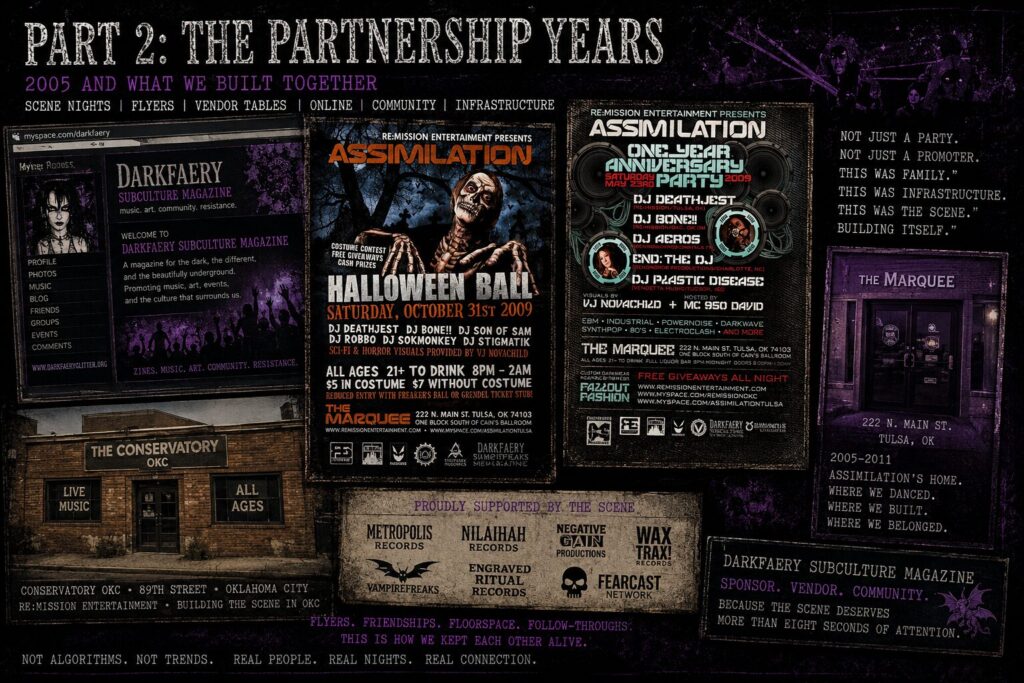
Assimilation ran tribute nights for Joy Division, Skinny Puppy, Depeche Mode, and the bands that had shaped the rooms we were still standing in. It ran Halloween Balls and anniversary parties. It eventually found its home at the IDL Ballroom at 230 East 1st Street in downtown Tulsa, a venue in the Blue Dome District that could hold a real crowd and still feel like it belonged to the people inside it.
We were there.
Not just in the audience.
On the flyers and at the vendor tables, which are two different kinds of presence and both matter.
Darkfaery Subculture Magazine showed up at Assimilation events as a sponsor and as a vendor. That meant we were helping promote the nights, but it also meant we were physically in the room with a table, talking to people, putting the magazine and the project into the hands of people who understood what it was for.
That is a different relationship than coverage from a distance.
That is being part of the infrastructure.
The surviving flyers matter because they prove what memory already knew. Darkfaery Subculture Magazine appears in that world not as a tourist, not as an outsider, but as part of the same ecosystem as Re:Mission Entertainment, Metropolis Records, Nilaihah Records, Negative Gain Productions, Wax Trax! II Records, VampireFreaks, Engraved Ritual Records, Fearcast Network, and other underground names that helped carry the music and culture through those years.
There is a kind of legitimacy that does not come from permission.
It comes from showing up often enough that people start expecting you to be there.
That was the work.
In Oklahoma City, Re:Mission’s Halloween Ball at Purgatory on North Classen was another anchor point of that era. The flyer said eight until two. Five dollars in costume, seven without. DJs Parasight, Bone, Deathjest, and Ed Crunk. Toxic Goddess at the door in full costume, signing photos and handing out giveaways, making the entrance worth the price of admission before anyone even got inside.
Toxic Goddess was Dirk Hooper and Robert Craze Henry, and what they were building in those years was genuinely interesting before the phrase alternative modeling was flattened into something safe enough for mainstream consumption. Part modeling project, part art movement, part proof that underground beauty did not need permission from anyone’s commercial standard.
Their work overlapped with the same world we were documenting. Photography. Fetish art. Burlesque. Gothic presentation. Alternative modeling. Event performance. Rooms where the line between audience and participant was always porous.
That mattered too.
Because the underground only works when the people in it actually support each other, not when they simply occupy the same space and call it community.
That was the best part of those years.
The sense that the scene was a living machine made out of people. DJs, photographers, promoters, dancers, models, musicians, designers, writers, vendors, door workers, performers, zinesters, weird kids, elder goths, baby bats, horror fans, industrial kids, vampire kids, steampunks before the steampunk wave had fully crested, and the people who never fit neatly into any category but belonged anyway.
The magazine was not separate from that.
It was one of the ways the machine remembered itself.
Here is what putting your name on a flyer meant in 2005, in a way it does not mean the same thing now: there was no algorithmic reach behind it. No engagement metric. No share button carrying your name to people who had not already decided to find you.
There was a physical piece of paper that someone held in their hands.
Either your name was on it or it was not.
That was the reach.
We were on those papers.
That was the whole thing, and it was enough.
The 2005 digital artifacts matter too. Old graphics from that period show Darkfaery Subculture Magazine promoting music, MySpace layouts, event coverage, and year-end culture before the magazine had returned to print. They look rough now in the way early internet work often looks rough: small images, compressed text, strange proportions, too much ambition packed into too little resolution.
But they are beautiful to me because they prove continuity.
They show that Darkfaery did not vanish.
It adapted.
From xerox to postal mail.
From zine to web page.
From web page to MySpace.
From MySpace to event flyers.
From event flyers back toward print.
Every era had its own tools. The job stayed the same.
Find the strange people.
Show them they are not alone.
Write it down before it disappears.
Some of what we built in that period is still standing. Re:Mission kept going, became a label, kept releasing music and running events out of Oklahoma City, which is more than most things from that era can honestly say. The relationships built through those nights outlasted specific events and specific venues. The work accumulated.
Some of it is gone, and that belongs in the record too.
The IDL Ballroom, where Assimilation found its long-term home, closed in 2021 after thirteen years in business. That kind of loss is always more than real estate. A venue holds what happened inside it. It holds the way people looked at midnight. It holds the songs that made the room move. It holds every conversation by the bar, every flyer left on a table, every person who walked in alone and left with somewhere to come back to.
When a venue closes, the building stops holding those memories for us.
So the archive has to.
That is part of why this history is being written now.
Not because everything was perfect. It was not.
Not because every date is clean, every flyer survived, every album is labeled, or every memory arrives with a neat citation attached. Underground scenes do not usually leave behind tidy records. They leave behind half-compressed images, old domains, broken links, photo albums, folded flyers, people’s names, and stories that have to be handled carefully before they scatter.
But enough survived.
Enough to prove the shape of it.
By the mid-2000s, Darkfaery Subculture Magazine was no longer only the thing I had made because there was no magazine for us.
It had become part of a network.
A sponsor.
A table.
A flyer logo.
A web presence.
A scene archive.
A reason to talk to the person standing next to you.
The partnership years taught us that a magazine could be more than pages. It could be a doorway into a room that already existed, a record of the people building that room, and sometimes one of the hands holding the door open.
The work did not stop when the format changed.
That was the point.
Return to Part 1: The Xerox Years, where this all started.
Continue reading: Part 3, The Convention Years, where Darkfaery Subculture Magazine moved from flyers, club nights, and online scene-building into convention tables, shadowcasts, Darkfaery Girls, horror events, and the public archive of a community that refused to stay hidden.