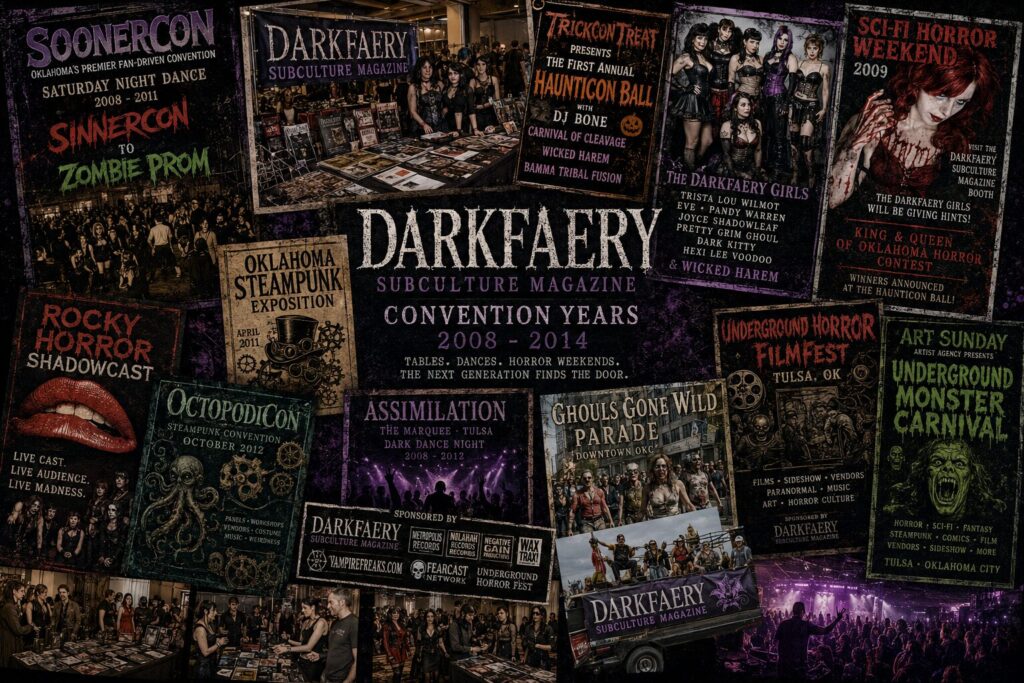
Tables, dances, horror weekends, and the public archive
There is a specific kind of energy that only exists inside a convention hotel at midnight.
You know the one.
Hallways full of people in elaborate costumes who have been wearing those costumes for twelve hours and are somehow still going. The dealer room closing while someone is still negotiating over a handmade corset. The panel that ran forty minutes over because nobody wanted it to end. The smell of cheap carpet, badge lanyards, hairspray, energy drinks, and the particular exhaustion that comes from doing something you genuinely love for three days straight.
From roughly 2008 to 2014, Darkfaery Subculture Magazine lived inside that energy on a regular basis.
And we did not go alone.
The Darkfaery Girls were essential to the convention years.
That needs to be said plainly before anything else, because they are the part of this history that tends to get underdocumented, and that is not a mistake we are going to keep making here.
Trista Lou Wilmot was first. She became the manager of the group, which tells you everything you need to know about the kind of presence she had and the trust she earned.
The core crew that built out the program from there included Eve, Pandy Warren, Joyce Shadowleaf, Pretty Grim Ghoul, Dayna E VanHauen, known as Dark Kitty, and Hexi Lee Voodoo: The Pin Up Ghoul.
Oklahoma women, all of them.
Goth and alternative models. Pin up performers. Sideshow artists. Event hosts. People who showed the world, as the group’s own description put it, that beauty does not have one face and dark culture does not have one look.
Eve brought her own troupe, Wicked Harem, with her into that work, which meant the Darkfaery Girls were never just a roster.
They were a network.
Several of the women moved between the Darkfaery Girls and the Carnival of Cleavage depending on the event and the need. When the lineup was not complete, we borrowed from friends in the scene, because the Oklahoma underground at its best was never precious about those boundaries.
You showed up.
You filled the gap.
You made the thing happen.
These were not competing organizations. They were a community sharing resources and showing up for each other.
The Darkfaery Girls were in the magazine from nearly the beginning of the relaunched print era. Issue 2, January 2010, featured them alongside the Carnival of Cleavage. But their role extended well beyond the pages.
At Assimilation, horror events, convention tables, balls, screenings, fashion shows, and public appearances, they were the physical presence of the magazine in the room.
“Brand ambassadors” is too corporate a phrase for what they actually did.
They were the magazine walking around, talking to people, making the thing real and human and approachable in a way that a table of printed copies never quite manages on its own.
They performed.
They appeared.
They showed up in full commitment and made every event better for being there.
The work they did in that period is part of why Darkfaery Subculture Magazine meant something to people rather than just existing.
The convention circuit itself was its own ecosystem.
SoonerCon was one of the anchors, and it deserves more than a passing mention.
Fan-run, volunteer-organized, born in 1986, paused after the 1997 convention, and reestablished in 2006, SoonerCon became one of the places where Darkfaery Subculture Magazine found the next version of its audience.
From roughly 2008 to 2011, Darkfaery was heavily involved with the Saturday night dance. In those early years, the dance carried the gloriously on-brand name SinnerCon. The last SoonerCon dance Darkfaery was part of was Zombie Prom, which feels exactly as correct as it sounds.
Those dances mattered because they were not just side entertainment after the panels.
They were where fandom, goth, industrial, horror, cosplay, and alternative nightlife started bleeding into each other in public. The kids who had come for anime or sci-fi or gaming could find themselves in a room with dark music, costumes, DJs, performers, and people who looked like the door into a larger underground had just opened.
Darkfaery had a table.
Darkfaery had flyers.
Darkfaery had people in the room.
We handed the magazine to people who had not found it yet and watched them understand immediately that it was made for them.
That was always one of my favorite parts.
The moment someone picked up the magazine and realized the door was open.
TrickConTreat was another important part of those years.
It sat directly in the overlap between horror fandom, Halloween culture, cosplay, gothic style, and the kind of community that had made peace with being called strange and decided to make it a whole personality.
The surviving flyers from 2008 show Darkfaery Subculture Magazine and TrickConTreat presenting the First Annual Haunticon Ball, with DJ Bone, Carnival of Cleavage, Wicked Harem, and Bamma Tribal Fusion.
That flyer matters.
Not because it is polished by modern design standards. It is not.
It matters because it proves the shape of the room.
The magazine was not only writing about dark culture. We were helping put events together. We were on the flyers. We were part of the night. We were helping make the space where people could show up in costume, perform, dance, meet each other, and become part of something larger than a weekend.
Sci-Fi Horror Weekend in 2009 belongs in that same record.
Darkfaery Subculture Magazine sponsored the event, had a booth, and helped create the King and Queen of Oklahoma Horror contest. The surviving public event copy invited people to attend Sci-Fi Horror Weekend, find the Darkfaery Subculture Magazine booth, sign up, get a number, and spend the weekend performing their horror-host duties while the Darkfaery Girls watched and gave hints.
The winners were to be announced at the start of the Haunticon Ball.
That is the kind of sentence that could only come from a very specific moment in Oklahoma dark-culture history.
A booth.
A contest.
A ball.
A horror host fantasy.
A group of alternative models giving hints to people trying to become local monster royalty.
That is not just event promotion.
That is world-building.
The horror events were their own branch of the archive.
TrickConTreat, Sci-Fi Horror Weekend, Oklahoma Horror Film Fest, Underground Horror Filmfest, Underground Monster Carnival, Blood Bath, Ghouls Gone Wild, and related Halloween-season events gave Darkfaery Subculture Magazine another kind of home.
These were places where horror was not a seasonal decoration.
It was a language.
A shared joke.
A survival tool.
A costume closet.
A reason to gather.
Art Sunday Artist Agency belongs in this part of the record too.
The surviving flyers and event listings around Underground Horror Filmfest, Underground Horror Fest, and Underground Monster Carnival show the exact kind of beautiful chaos that made those years what they were: local horror filmmakers, sideshow performers, models, vendors, paranormal groups, artists, bands, movie nights, costume culture, and Darkfaery Subculture Magazine tucked into the machinery as sponsor, media, vendor, or scene presence.
These events were not polished mainstream horror.
They were local horror as a living community.
People making films.
People building costumes.
People doing sideshow acts.
People making flyers that looked like they had been assembled in the dark by someone with three deadlines, two fonts, and no intention of apologizing.
That is not an insult.
That is the archive.
Ghouls Gone Wild was different from the others.
That was not a club night or a convention table. It was Oklahoma City spilling Halloween into the street.
The parade began in the late 2000s as Oklahoma Gazette’s Ghouls Gone Wild Parade, and by the time Darkfaery crossed into that orbit, it had already become one of those public events where the weirdos were not hiding in a back room anymore. They were walking downtown in full costume while the city watched.
There had been plans for a Rocky Horror after-party connected to that season, but the movie license fell through, which is exactly the kind of unglamorous detail that never makes the legend but always belongs in the archive.
So we adjusted.
We put on the costumes, walked in the parade, and made ourselves visible anyway.
The next two years, Darkfaery came back bigger.
We did a float.
Because once you learn that the city will make room for monsters in the street, you start thinking in larger props.
Rocky Horror was part of this period too, though the surviving archive needs a careful hand.
Some flyers document planned screenings. Some document live Rocky Horror events. Some events happened differently than the flyer promised because licensing, scheduling, venue changes, or ordinary underground chaos got in the way.
That is why this history is being written as an archive in progress, not a sealed museum plaque.
But the reason Rocky Horror mattered to us is clear.
If you have never experienced a shadowcast, performers in full costume act out the film live in front of the screen while the movie plays behind them. The audience participates. There are prop bags. There is decades-old call-and-response passed down through midnight screenings like a very specific form of oral tradition.
It is participatory theater in the most democratic and slightly unhinged sense of the phrase.
The Amazing Boobzilla co-managed shadowcast work alongside me. She had come up through shadowcast performance in Denver before Oklahoma, so she brought real craft and real performance history to what we were building together.
She also founded the Carnival of Cleavage, an all-women sideshow troupe that existed specifically to challenge the idea that only men could do the hard acts: sword swallowing, fire eating, the human blockhead, broken glass, feats of strength, the works.
She was essential to those performances, and this record would be incomplete without her in it.
What the shadowcast represented, beyond the obvious joy of it, was the magazine’s deepest belief made physically and loudly literal.
The people in this community are not just consumers of dark culture.
They are performers and makers and participants in it.
Darkfaery Subculture Magazine was never meant to be something you read from a safe distance.
It was always meant to be something you were inside.
The Oklahoma Steampunk Exposition debuted in April 2011, and I was convention staff.
Being staff is different from being a vendor or an attendee. It means you are inside the machinery of the thing, doing the work that makes it run, caring about it the way you care about something you helped build.
The first Oklahoma Steampunk Exposition was ambitious and chaotic and held together by sheer collective enthusiasm, which is the only honest way to describe most first conventions.
Guests cancelled at the last minute when travel funding fell through. The printed program showed up partway through the second day. The schedule shifted because everyone was having too good a time to stick to it.
None of that mattered.
The people in that room were the right people. The steampunk, gothic, horror, maker, costuming, and alternative communities in Oklahoma had been waiting for something like this, and when it happened, we were part of making it happen.
OctopodiCon launched in October 2012, also steampunk-themed and deliberately weird in the best sense.
It held panels on things like Steam Cthulhu and the relationship between steampunk and actual history. It took the aesthetic seriously as a cultural conversation rather than treating it as only a costume contest, which is rarer than it should be.
I was staff there too.
The second OctopodiCon is where things started to change for me personally.
I attended.
I could not work.
The health issues that had been building through that period had reached a point where showing up was itself the effort, and that was a different kind of presence than the one I was used to bringing.
I am not going to detail the illness here.
What I will say is that you learn something about the people around you when you can no longer be the one holding things together, and what I learned is that the community I had spent years building was worth every year it took.
The convention years also gave us something the club nights and music events had not in quite the same way: direct access to the next generation.
The kids coming up through anime fandom and cosplay were finding their way toward gothic and horror culture. Some of them needed someone to hand them a magazine and say: yes, there is a whole world here, it has been here longer than you know, and you belong in it.
We handed a lot of magazines to a lot of people between 2008 and 2014.
Some of them are still in the community now.
Some of them are making their own work.
That is not a small thing.
It is easy to talk about those years as if they were only about events.
They were not.
They were about visibility.
The table with the banner.
The flyers.
The photo albums.
The costumes.
The models and performers and DJs and vendors.
The conversations in dealer rooms.
The person who stopped walking because they saw the word Darkfaery and realized maybe this was for them.
The strange kids finding each other again, only now they had badges around their necks and camera phones in their hands and the archive was happening whether anyone understood that yet or not.
2014 was the last year Darkfaery Subculture Magazine was in print.
The illness that had started making itself known had not eased, and the infrastructure that holds a print publication together requires more than belief and stubbornness, though we had plenty of both.
The magazine went quiet.
Not gone.
Quiet.
The convention years ended not with a clean conclusion but with the particular kind of fade that happens when life interrupts and the person holding the thing together needs to put it down for a while.
The Darkfaery Girls kept existing.
The community kept existing.
The relationships built across six years of convention floors, dealer tables, parade routes, midnight events, horror weekends, SoonerCon dances, Assimilation nights, and photo albums kept existing.
We documented what we could while we could.
The rest of the record is the people who were there and remember it, and this history, written now, trying to make sure the names and the nights do not disappear just because the internet was not paying attention.
Trista Lou Wilmot.
Eve and Wicked Harem.
Pandy Warren.
Joyce Shadowleaf.
Pretty Grim Ghoul.
Dayna E VanHauen, Dark Kitty.
Hexi Lee Voodoo: The Pin Up Ghoul.
The Amazing Boobzilla.
Carnival of Cleavage.
Toxic Goddess.
DJ Bone.
The DJs, photographers, performers, models, vendors, staff, friends, volunteers, horror hosts, filmmakers, and strange beautiful people who made the rooms worth remembering.
They were there.
They were essential.
They are in the record now.
Archive note: This history is built from personal memory, surviving flyers, old photo albums, archived web pages, event listings, print issues, and the people who were there. Underground scenes were not always documented cleanly. Dates, names, captions, and event details may be updated as more flyers, albums, and community memories surface.
Return to Part 2: The Partnership Years, where Darkfaery Subculture Magazine moved from old internet survival into music, events, sponsorships, flyers, tables, and the rooms where the next version of the community was waiting.
Archive note: We are still sorting permissions, captions, dates, and photo credits for the convention-era albums. This page may be updated as more flyers, photos, and community memories are confirmed.