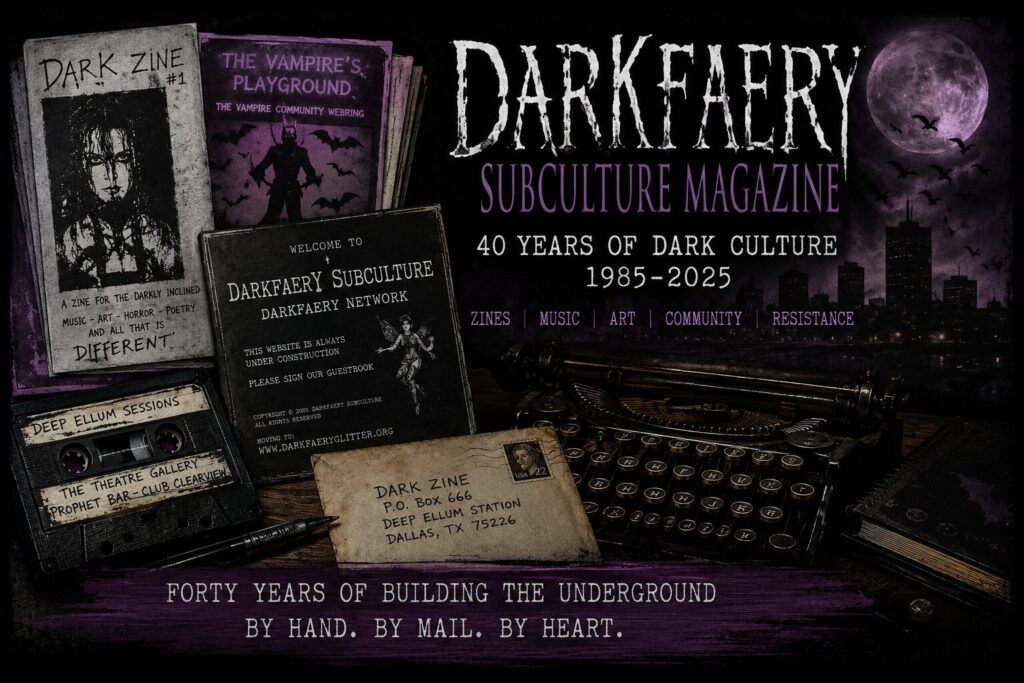
Forty years of strange kids finding each other
The work that became Darkfaery Subculture Magazine began forty years ago.
Not with a business plan. Not with a brand guide. Not with a launch strategy or a media kit or anyone waiting for permission.
It began with a weird kid in Dallas, Texas, standing at a xerox machine.
I was born in 1971, so in 1985 I was thirteen going on fourteen, making a zine by hand because there was no magazine for people like me. Not where I could reach it. Not where I could hold it. Not where it said the thing I needed to hear at that age: if you are strange, if you love dark art and horror and music that makes other people nervous, if you do not fit the school you are trapped in five days a week, you are not alone.
The first version was called Dark Zine.
No flourish. No subtitle. No branding. Just the thing that it was, named plainly, because the content was the whole point. Horror. Dark art. Music that unsettled people. Writing that did not apologize for being strange. Pages folded by hand and mailed to strangers who found me the same way I found them: through postal mail, pen pal services, and the underground networks weird kids used before the internet gave us faster and lonelier ways to reach each other.
They signed up by mail. I sent issues by mail. The whole operation ran on stamps, copied pages, and a willingness to stand at a xerox machine longer than was probably reasonable for a teenager on a school night.
I did not know I was building something.
I just knew I could not stop making it.
By the time I was sixteen or seventeen, I was already in the venues. Too young by anyone’s official count. Nobody seemed particularly bothered. Deep Ellum was becoming what people would later remember it as, and in the mid-1980s it was still raw enough that a kid who showed up and wanted to work the door was not exactly turned away.
The Theatre Gallery was the first real place I understood as mine.
Russell Hobbs had opened it in 1984 in an empty warehouse, and it operated in two distinct registers. The art gallery up front was clean and almost civilized. Then you walked farther in and found something else entirely. Bare rafters. Concrete floors. The smell of stale beer and whatever everyone had brought with them. A room that did not apologize for what it was.
I worked the door there as a volunteer, which meant I stood at the threshold and watched the whole thing happen in real time.
Bands that no one outside a few downtown streets had heard of played on a stage that had no business being as important as it turned out to be. The Theatre Gallery’s management company eventually spun off the Prophet Bar, which is where I spent the rest of my time. Jim Heath, who became Reverend Horton Heat, was playing Monday nights after getting pushed out of his previous band. I wrote about those nights. I wrote about the Butthole Surfers, who were from San Antonio but made Deep Ellum feel like their natural habitat. I wrote about Edie Brickell before she was Edie Brickell to anyone outside that specific zip code.
Across the street and down the block, Club Clearview had opened too, Jeff Swaney turning a warehouse that had hosted outlaw parties with generator power and unsanctioned beer into something with actual walls and a liquor license and five rooms that could hold entirely different crowds at the same time.
I haunted all of it.
What I was doing, I understood only later, was journalism.
At the time it just felt like the only reasonable response to what was happening around me. These bands were fighting for something they could not name yet. The scene was adrift in the specific way scenes are adrift before they understand their own significance. The energy was real and the talent was real and the rooms were full of people who sensed that something mattered, but nobody had organized it into a coherent story.
It was not the kind of scene that had already made peace with what it was.
It was still becoming.
I loved it for exactly that reason.
I was also a passable vocalist cycling through bands, looking for my spot, never quite finding it. The writing was the constant. The writing was where I actually belonged.
What I did not have in Dallas, not fully, was a crew.
Deep Ellum was a place I loved with my whole chest, but it was still a handful of streets in a city that did not particularly care about those streets yet. The connections were real but fragile. You had to know exactly where to be and when, and even then the community had gaps in it.
I was in the room, often.
I was of it less than I wanted to be.
That distinction matters when you are seventeen and building something and looking for the people who will build it with you.
Oklahoma gave me that.
I moved in 1991, and what I found there was not what I expected, which is its own kind of gift.
Oklahoma was raw in a different way than Dallas had been. Uncensored and unapologetic and operating right in the middle of serious, organized Christian resistance. They tried to witness to us outside venues. They pushed to have events shut down. They wrote letters and held meetings and made public noise about what we were doing to the young people, by which they meant us, by which they meant everyone in the room making music and buying cassettes and just trying to live in the way that made sense to them.
It only pulled us tighter together.
You could buy cassettes in parking lots from people who made them themselves. You could have an actual conversation with a band from out of state after the show, standing around in the same space, no backstage, no separation, no myth of celebrity between the people making the music and the people it was made for.
It felt like someone’s living room and everyone in it knew everyone else.
Your friends knew all your friends. Instead of being confined to a handful of streets in downtown Dallas, we had Oklahoma City and Tulsa as a playground. Punk shows and music nights and rooms that held maybe a hundred people on a good night and felt like the entire world.
A scene.
A real one.
With its own artists and photographers and writers and musicians and arguments and history and people who showed up every single time because they did not have anywhere else they would rather be.
That scene deserved to be documented.
I knew it the first time I saw it, and I never stopped knowing it.
So Dark Zine kept evolving.
It went through changes I will not detail here because some of them were about survival more than creativity, and that is a longer and more personal story. What I can tell you is that by 1993 it had a new name: The Vampire’s Playground.
It was the right name at the right moment in the right city for exactly the right crowd. Gothic and sharp and not remotely interested in explaining itself to anyone who did not already understand it.
The Vampire’s Playground became more than a zine. It became a web presence. It became The Vampire Community Webring. It became one more little doorway in the old internet, back when a doorway could be a Tripod page, a guestbook, a banner, a list of links, and the stubborn belief that the right people would eventually find it.
In 2001, that doorway changed signs.
The Vampire’s Playground and The Vampire Community Webring became Darkfaery Subculture and Darkfaery Network.
That first Darkfaery page was not polished in the modern sense. It was old internet, gloriously so. Guestbooks. Copyright notices. Pages always under construction. A move notice. The kind of site that looked handmade because it was handmade.
But the name was there.
The direction was there.
The door had changed signs, but it was still the same door.
That is why this history matters now. Darkfaery Subculture Magazine did not appear from nowhere in the 2000s. It did not begin with print tests, convention tables, MySpace graphics, event flyers, or glossy covers. Those things came later.
The work began in 1985 with xeroxed pages and postal mail.
It became Dark Zine.
It became The Vampire’s Playground.
It became The Vampire Community Webring.
It became Darkfaery Subculture.
It became Darkfaery Network.
Eventually, it became Darkfaery Subculture Magazine.
And the reason it exists has never been complicated: there was no magazine for us, so we made one, and we left the door open.
It is still open.
Continue reading: Part 2, The Partnership Years, where Darkfaery Subculture moved from old internet survival into music, events, partnerships, flyers, tables, and the rooms where the next version of the community was waiting.
Continue reading: Part 3, The Convention Years, where Darkfaery Subculture Magazine moved from flyers, club nights, and online scene-building into convention tables, shadowcasts, Darkfaery Girls, horror events, and the public archive of a community that refused to stay hidden.
Archive note: We are still sorting permissions, captions, dates, and photo credits for the convention-era albums. This page may be updated as more flyers, photos, and community memories are confirmed.