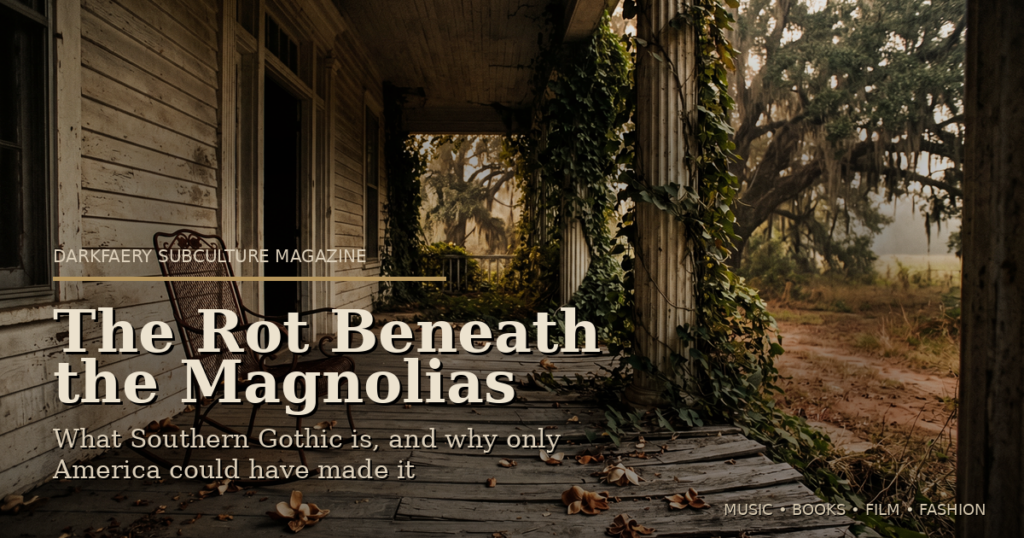
The Rot Beneath the Magnolias: What Southern Gothic Is, and Why Only America Could Have Made It
European Gothic needed a castle. Southern Gothic only needed a porch.
That is the shortest way to say it, but it deserves the long way too, because Southern Gothic is one of the few dark traditions that did not arrive in America by boat. It grew here, out of red clay and bad history, and it now runs through our music, our books, our films, and lately our closets. Before we follow it through each of those rooms, we should be honest about what it actually is, because the word “gothic” is doing different work down South than it does anywhere else.
The Difference: Stone Versus Soil
Classic Gothic, the European strain, is an architecture of dread. Crumbling abbeys, mad monks, ancestral curses, fog on the moor. Its horror is aristocratic and old. The threat comes from a past so distant it has calcified into legend, and the buildings themselves are the monsters: Otranto, Udolpho, Dracula’s castle.
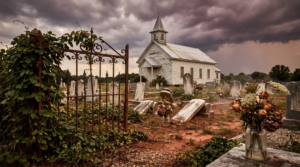
Southern Gothic kept the decay and threw out the distance. Its ruins are not eight hundred years old. They are one or two generations old, and the people who built them are buried in the churchyard down the road, and everyone at the dinner table knows exactly what they did. The haunted house is not a metaphor for some vague ancestral sin. It is the plantation house, and the sin has a name.
That is the real difference. European Gothic asks, what terrible thing happened here long ago? Southern Gothic asks, what terrible thing happened here that we are all still pretending did not happen? The horror is not supernatural distance. It is proximity. It is the family secret, the unmarked grave, the polite silence at the church picnic.
A few other distinctions worth keeping in your pocket:
Heat instead of cold. European Gothic is drafty corridors and winter. Southern Gothic is humidity, kudzu, sweat through a Sunday dress, things rotting fast because everything rots fast in that climate. The South does not preserve its dead. It composts them.
The grotesque instead of the monstrous. Dracula is a monster. Flannery O’Connor’s Misfit is a man, and that is worse. Southern Gothic populates itself with damaged preachers, con artists, lonely freaks, and saints who do not know they are saints. The genre’s great trick is making you love them anyway.
Faith as a live wire. European Gothic treats religion as atmosphere, all candles and Catholic mystery.
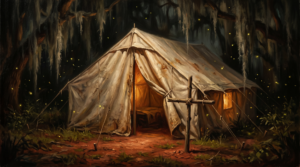 Southern Gothic treats it as voltage. Hellfire is preached in tents, salvation is screamed about, and God is not a distant architect but a presence pressing down on every character like the heat itself.
Why It Could Only Be American
Three things had to converge, and they only converged here.
First, a lost war on home soil. The former Confederate South is the part of the United States most publicly organized around the memory of a lost war, defeat, occupation, and the mythologizing of its own ruin. That produced a culture that lives inside its own ghost story, narrating a grandeur that was always partly a lie, built as it was on enslaved labor. Southern Gothic is the literature of that lie decomposing in public.
Second, slavery and its long afterlife. This is the center of the genre, and there is no honest version of this article that dances around it. The “haunting” in Southern Gothic is, again and again, the unfinished business of American racial violence. Toni Morrison’s Beloved makes the metaphor literal: the ghost is a murdered child, and the murder was an act of desperate love inside a system designed to destroy love. No imported Gothic template could have produced that book in quite the same way. It required this country’s specific crime.
Third, evangelical Protestantism. Not religion in general, but the revival-tent, hellfire-preaching, salvation-haunted strain that flourished through much of the rural South. It gave the genre its vocabulary of sin, grace, damnation, and grotesque redemption, and it gave generations of Southern writers something enormous to wrestle with.
Take away any one of those three and you get a different genre. Together, they make something that could only grow in this country’s soil, the way certain flowers only bloom in certain kinds of rot.
The Books: Where the Tradition Was Named
Literature is the root system. William Faulkner built the county, Yoknapatawpha, where time refuses to move forward and the past is, in his famous formulation, not even past. Flannery O’Connor supplied the theology and the body count, writing stories where grace arrives like a gunshot. Carson McCullers gave the tradition its loneliness, Harper Lee gave it its conscience, and Cormac McCarthy dragged it out of the parlor and into the woods, where it got considerably bloodier.
The lineage did not stop in the twentieth century. Jesmyn Ward’s Sing, Unburied, Sing is a full-blooded Southern Gothic novel published in our lifetime, ghosts and all, and it makes the essential point that Black Southern experience is not an addition to Southern Gothic. It is central to it, and some of the strongest contemporary work comes from writers reclaiming the haunted house from the inside.
If you read one book to understand the genre, read O’Connor’s stories. If you read two, add Beloved and let them argue with each other.
The Films: The Preacher with the Tattooed Knuckles
Cinema found its Southern Gothic masterpiece early. The Night of the Hunter, from 1955, gave us Robert Mitchum as a murderous preacher with LOVE and HATE inked across his fingers, hunting two children down a moonlit river. Every brooding man of God in film and television since owes him royalties.
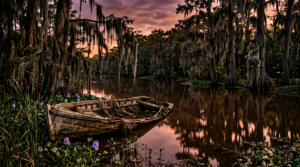
The tradition runs through Eve’s Bayou, one of the most underrated American films of the nineties, a Louisiana story of memory, infidelity, and second sight told entirely through a Black Creole family. It runs through the swamp-myth poetry of Beasts of the Southern Wild, the river-rat fable of Mud, and the first season of True Detective, which dressed a serial killer procedural in Spanish moss and folk-horror iconography and reminded mainstream audiences that Louisiana is the most haunted-looking place in the country.
What unites them on screen is texture. Southern Gothic film is shot in golden rot: peeling paint, brown water, light coming through dust. The camera lingers on decay the way European Gothic lingered on stone.
The Music: From Murder Ballads to Ethel Cain
Here is where the tradition is most alive right now, and where our readers most likely already live.
The musical bloodline starts with the murder ballad, those old Appalachian and Southern songs where somebody’s sweetheart ends up in the river by verse four. It runs through the spirituals and the blues, through Johnny Cash’s gallows narrators, and then, in the nineties, it mutates into something the underground started calling gothic country or gothic Americana. Denver’s 16 Horsepower, and David Eugene Edwards’s later project Wovenhand, fused punk intensity with Pentecostal dread and banjo, and built a sound that felt like a revival tent on fire. The Handsome Family wrote parlor songs about drowning. Murder by Death scored imaginary Westerns about the devil. Those Poor Bastards made country music that sounds genuinely cursed.
And then the tradition produced a star. Ethel Cain, the project of Florida-raised Hayden Anhedonia, took the whole inheritance, the preacher’s daughter mythology, the doomed Americana, the cannibalized bodies and gas station Madonnas of Preacher’s Daughter, and turned it into one of the defining dark-pop mythologies of the decade. Her work matters to this conversation because it proves the genre is not a museum. A trans woman from the Florida panhandle is currently its most visible author, writing the haunted South from the perspective of people the old South tried to erase. That is exactly how a Gothic tradition stays alive: the ghosts change sides.
The Fashion: Mourning Clothes in the Heat

Southern Gothic style is the least codified of the four, which makes it the most interesting to watch right now. It is not the European goth uniform of leather and PVC. It is closer to what you would find in a dead grandmother’s cedar chest: cotton slips gone ivory with age, prairie dresses, lace collars, mother-of-pearl buttons, a tarnished cross on a thin chain. It borrows from Victorian mourning dress but wears it barefoot, in the heat, slightly dirty at the hem.
The palette is not the cold monochrome of club goth. It is bone, rust, dried blood, tobacco, cream. Workwear sits next to christening gowns. The look says funeral, but a funeral held outdoors in August, where the makeup runs and nobody minds. Ethel Cain’s visual world did a great deal to push this aesthetic into the wider subculture, and you can now trace its fingerprints through independent designers, vintage sellers, and half the moodboards on any given platform. It is mourning dress for a country that never properly mourned, which may be the most Southern Gothic sentence in this entire article.
What Holds It All Together
Across every medium, Southern Gothic is doing one job: it refuses the official story. The official story says the past is settled, the dead are buried, the family is fine, the town is friendly, the nation is innocent. Southern Gothic walks into that story with muddy boots and points at the floorboards.
That is also why it belongs in a magazine like this one. Subculture has always been the place where the unmourned get their funeral. Southern Gothic is simply the American South doing the same work through fiction, film, fashion, and song that our scenes do through music and dress: insisting that the dark parts of the story be told out loud, beautifully, and on purpose.
The castle never made it across the Atlantic. The ghosts did fine without it.